The short answer: yes, but it is hard
We looked at 63,963 Shopify stores that had ads running on Meta (Facebook and Instagram) on 28 September 2026. Together they had 2.5 million ads live. That is not the whole market, only the stores Ads Bench tracks. We explain the limits at the end.
The data shows two things. New stores can still grow fast. But most give up early, and a few big stores hold almost all the ads.
Why look at ads? Because a store rarely keeps many ads running, week after week, unless it is selling. Advertising a lot, for a long time, is the best public sign that a store is making a profit. That is what we measure here.
A few stores hold almost all the ads
Half of all stores have 5 active ads or fewer. One in five has just one.
At the other end, 1 in 10 stores holds three quarters of all ads (77%). The 639 biggest, just 1% of stores, hold more than a third (36%). And the bottom half, almost 32,000 stores, shares less than 3%.
In other words, most stores you see in the Ad Library are testing on a small scale. Only a few are really growing.
| Active ads per store | Stores | % of stores |
|---|---|---|
| 1 | 13,139 | 20.5% |
| 2 to 4 | 16,092 | 25.2% |
| 5 to 19 | 19,166 | 30.0% |
| 20 to 99 | 11,044 | 17.3% |
| 100 or more | 4,522 | 7.1% |
Shopify stores with at least one active Meta ad on 28 September 2026 (63,963). Percentages add up to 100.1% because of rounding.
New stores still reach the top
We call a store new if it opened in July 2026 or later. To be sure, we check two dates. The oldest product on sale in the store must be from July or later. And we must have no ad from it before July. Ads alone are not enough, because a store may have advertised earlier without us seeing it.
Of the 6,396 stores running the most ads (the top 10%, each with 67 active ads or more), 1,022 are new stores. That is about 1 in 6. Among the 639 biggest, there are 33.
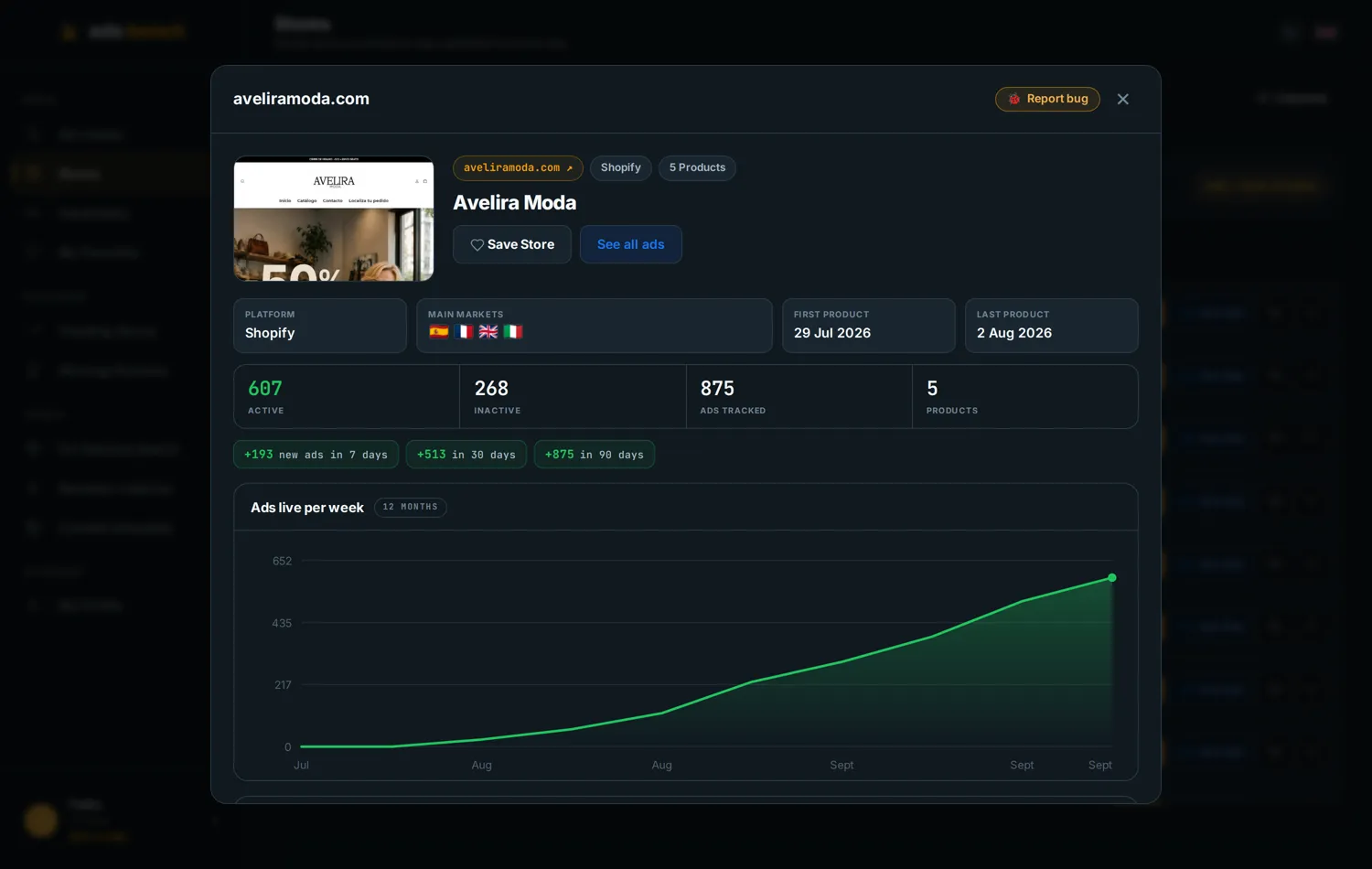
The store in the picture is one example. Its oldest product is from 29 July, and its first ad from 1 August. By the end of September, it had 607 active ads.
A store rarely keeps adding ads like that, week after week, without making sales. In other words, there is still room for a new store to grow fast.
More than half of new stores quit in their first month
We followed the 6,985 new stores that started advertising in July 2026 through to the end of September.
3 in 10 stopped advertising within the first week. In total, more than half (57%) stopped before their first month was up. Of those that stopped, half did so within 8 days.
Only 36% were still advertising two months after they started.
| New stores that started in July | % of 6,985 stores |
|---|---|
| Stopped in the first week | 29.9% |
| Stopped between day 8 and day 29 | 27.4% |
| Reached 30 days or more | 42.7% |
The three rows add up to 100%. “Stopped” means no active ad left. Two months: 35.6% of the 6,391 stores that started by 29 July.
Most ads are switched off within days
It is not just stores: ads don’t last long either. Shopify stores launched 1.1 million creatives in July (each different image or video counts as one). More than half (54%) were switched off within 7 days. Only 1 in 5 (20%) stayed live for 30 days or more.
That is normal: the store tests, keeps what sells running and switches off the rest. But it costs money. If only 1 creative in 5 lasts a month, your budget also has to pay for the other 4.
Testing more creatives made no difference
We expected new stores that test more creatives in their first week to last longer. That is not what we saw. Among those that got past the first week, about 3 in 4 reached 30 days, whether they launched 1 creative or 30 or more.
Among July’s new stores, video or images made almost no difference either: 42% reached 30 days with one or the other, and 46% when they mixed both. Copying other stores’ creatives did not help: stores that started with mostly copied creatives reached 30 days as often as those that only used their own (41%).
This suggests that the number of tests alone does not keep a store going. The product, the offer and the numbers come first.
| Creatives launched in the first week | Stores | Reached 30 days |
|---|---|---|
| 1 | 3,277 | 77.5% |
| 2 to 3 | 2,831 | 75.6% |
| 4 to 9 | 3,205 | 73.7% |
| 10 to 29 | 1,838 | 74.0% |
| 30 or more | 562 | 76.3% |
New Shopify stores that started advertising between 1 July and 29 August 2026 and were still advertising on day 7 (11,713).
Do the math before you start
Since most tests fail, every sale also has to pay for the tests that did not work. Before you start, work out how much you can spend on ads per order without losing money: your selling price minus the product cost, shipping, fees and returns.
Across the 741 winning products we measured in September, the typical store sold at 4.4 times the AliExpress supplier price. A product sold at less than 3 times its cost leaves little money for testing. The step-by-step is in our article on dropshipping profit margin.
Decide in advance how much you will spend per product and when you will switch an ad off. Without that limit, a test is just spending.
How to decide whether it is worth it for you
Before you open a store or test a new product, answer these questions:
| Question | Where to check |
|---|---|
| Are stores advertising this product for more than 30 days? | The winning products ranking or the guide to finding winning products |
| How many other stores use the same ads? | The saturation checklist |
| Can you sell for more than 3 times the supplier cost? | The guide to finding suppliers by image |
| How much can you spend on ads per order? | The margin article |
| Does your money cover the tests that will fail in week one? | Your testing plan, before the first ad |
| What are your competitors advertising right now? | The guide to seeing competitors’ Facebook ads |
Limits of these numbers
Ads Bench does not have every Meta ad. We find stores through daily searches in the Ad Library. We started in July 2026, also fetching the previous three months, and the database has kept growing since. That is why we do not compare months or talk about trends.
To tell whether a store is new, we use the date of its oldest product on sale and of the first ad we have. An old store that deleted all its products and started over can pass as new.
Stores that advertised for only a day or two may never have shown up in our searches. If so, the real drop-off is even higher.
We check each ad daily in its first week, weekly up to 30 days and monthly after that. Some ads counted as active at the end of September may already have stopped.
Frequently asked questions about dropshipping in 2026
Does dropshipping still work in 2026? For some stores, yes. Among the stores running the most ads today, 1 in 6 opened in July 2026 or later. But more than half of new stores stop advertising before their first month is up.
Is dropshipping still profitable? For stores that get the product right, yes. The top stores keep dozens or hundreds of ads running for weeks, and that is hard to sustain without sales. To know whether a product can be profitable for you, do the margin math before you test.
Is dropshipping saturated? The top is concentrated: 1 in 10 stores holds three quarters of the ads. But saturation is measured per product. See how in the saturation checklist.
How quickly do stores give up? Fast. Of the new stores that stopped, half did so within 8 days. And more than half of creatives are switched off within a week.
Data: Meta Ad Library ads collected by Ads Bench up to 28 September 2026, Shopify stores only (63,963 with active ads). New store: oldest product on sale and first recorded ad from 1 July 2026 or later (products read from the store itself). Prices: margin article of 27 September 2026 (741 products).