What does a saturated dropshipping product mean?
For a new store, saturation is a practical concern: comparable offers compete for the same customers while leaving little room for a useful difference. It is specific to a country, audience, variant and offer. A product seen everywhere in your feed may face different competition elsewhere.
Separate product saturation from creative fatigue. Repeating a video does not establish that nobody will buy the product. One weak test can also reflect the offer, website or delivery conditions.
If you have not shortlisted a product, start with how to find winning products for dropshipping. This guide covers the next decision: how much room your specific offer might have.
1. Define the product and market before counting competitors
Record the function, exact variant, country and customer. Search product names and problem-led phrases in the Meta Ad Library. A window-track cleaning brush may appear under cleaning-tool or window-cleaning wording.
Open the destination. A refill, single item and bundle are different offers even with the same photo. Record the date and repeat relevant searches. Results are a sample, not the whole market.
2. Count stores separately from pages and ad copies
In Ads Bench, inspect the destination store and compare associated advertiser pages. Grouping by creative helps identify reused videos or images. Check the domain before counting another competitor.
The historical example in our competitor guide shows 57 advertiser pages associated with one store. Counting pages can exaggerate competition. It does not prove dropshipping or that every ad remains active.
Use the store ad-count guide to separate ads, creatives, pages and domains. Record uncertain matches as uncertain.
3. Compare creative angles and complete offers
Record the ad opening, demonstrated benefit, variant, bundle and delivery promise. Three identical offers leave a different opening from three offers aimed at distinct uses.
Look for a difference you can verify: an accessory solving another problem, a clearer demonstration or a tested delivery service. Changing a logo or copying a video does not create a useful product difference.
Use the creative analysis worksheet for your own brief. High copy counts indicate reuse, not profitable campaigns.
4. Verify supplier matches and equivalent delivered prices
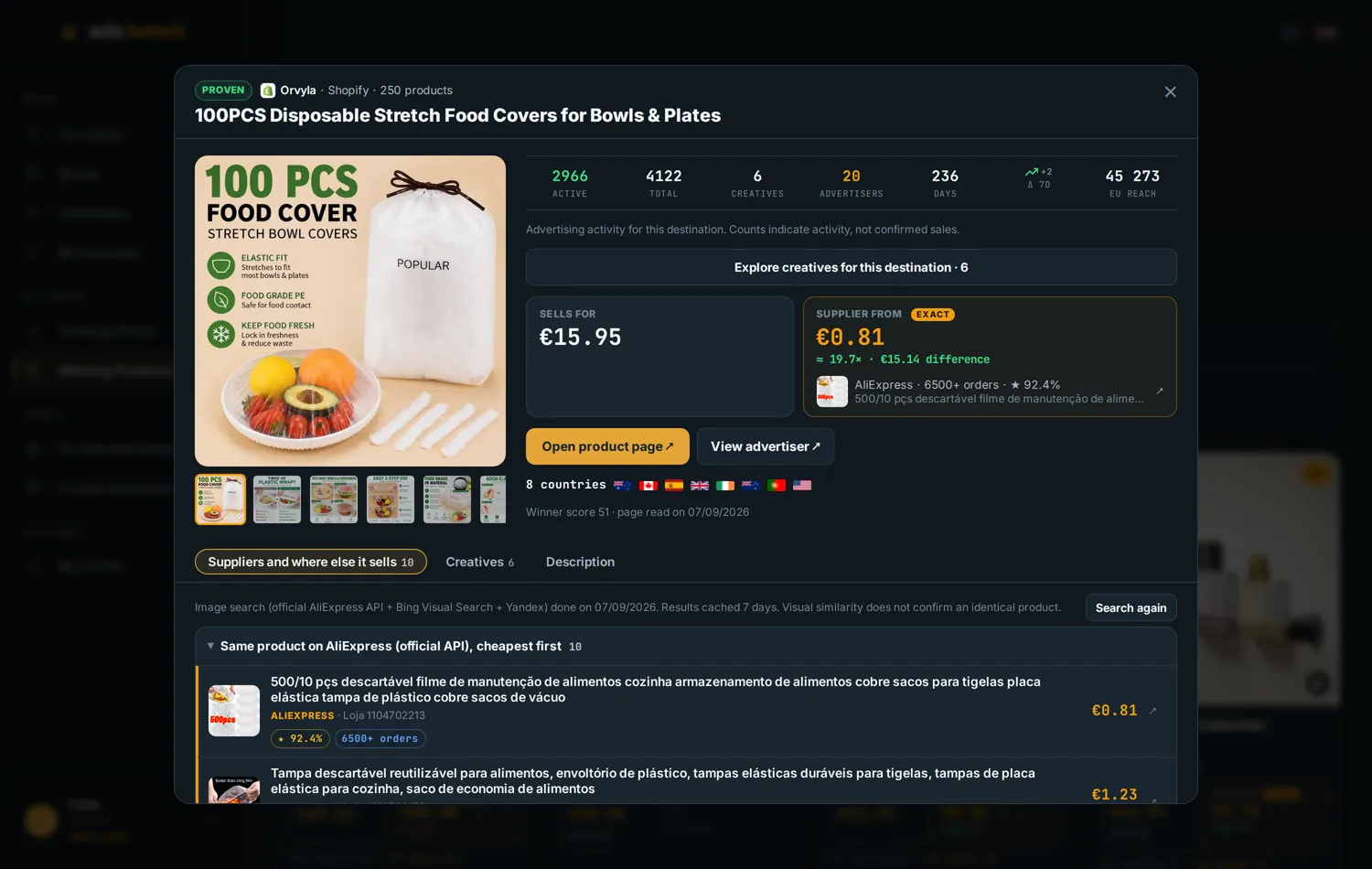
The historical Ads Bench screenshot below shows a €15.95 store listing beside a €0.81 supplier result. The €15.14 gap is not available profit: variant, quantity and delivery terms must first match. These are screenshot values, not current quotes.
Open original listings and compare materials, dimensions, quantity, packaging and delivery. A cheaper photo match may be an accessory or a smaller variant. Request a sample before basing an offer on it.
Follow how to find dropshipping suppliers by image. Then check whether your own fulfilment and acquisition costs leave room at a competitive price.
5. Revisit the same stores before choosing a test
Save a dated record and revisit the same stores using the same country and filters. Note offer changes, new creatives and delivery promises. More ads may reflect tests; fewer visible ads may reflect collection coverage or an ended promotion.
Avoid universal rules such as “ten stores means saturated” or “thirty days live means profitable”. Your output should be a supported decision: test a differentiated offer, investigate a missing fact or set the candidate aside.
A product saturation worksheet to copy
Use one row per store and record unknowns explicitly. The last column should explain your next action, not produce a made-up saturation score.
| Field | What to record |
|---|---|
| Market | Country, language and date |
| Product | Variant, quantity and specifications |
| Store | Domain and confirmed advertiser pages |
| Creative | Hook, demonstration and offer |
| Delivery | Total price and promised timeframe |
| Supplier | Equivalent variant and sample status |
| Next action | Difference to test or fact to verify |
Example decision: a window-track cleaning brush
Suppose three stores in your country show the same brush with the same demonstration. This is an illustrative scenario, not a measured market count. Check whether the offers include the same number of brushes and comparable delivery dates.
If your plan is the same item, slower delivery and a higher price, the current offer has no clear advantage. If a tested accessory bundle solves an additional problem, you have a hypothesis to evaluate. Neither conclusion requires saying the entire category is saturated.
Explore competitor ads and the Ads Bench product ranking to build a shortlist. Confirm source observations before choosing a candidate.
Dropshipping product saturation FAQs
How many sellers make a product saturated? There is no universal threshold. Count comparable stores in your market and assess your specific offer. Several pages may represent one store.
Does lots of advertising mean a product sells? It is the best public sign that it does: few stores keep many ads running for weeks without sales. But many stores selling the same product can also point to saturation, so compare the offers before you enter.
Can I research saturation for free? Yes. Use the Meta library, store pages and supplier listings for a manual comparison. Ads Bench helps connect available observations; the demo shows the workflow.
Can a popular product still deserve a test? Potentially, if you can deliver a meaningful difference. Verify product and logistics, then judge results using your own store data.
Method: editorial comparison checklist, not a validated saturation score. Product screenshot: Ads Bench, 7–8 September 2026. Store-page example: competitor guide published on 10 September. The three-store scenario is hypothetical.