The short answer: finding is easy, filtering is the work
There are two jobs here. The first is finding Shopify stores, and the four methods below do it in a few minutes. The second is filtering them, and that is where most people get stuck: a list of 100,000 stores is useless if most of them are tests, abandoned shops or stores spending on ads that do not convert.
Sales are private on Shopify. What is public is advertising: the Meta Ad Library shows every active ad of every store, with its start date. A store that keeps paying for the same ads for months, and keeps adding new ones, is almost always selling. That is the filter in this guide, and the numbers come from the 117,102 Shopify stores Ads Bench tracks.
4 ways to find Shopify stores
1. Google with search operators. Search site:myshopify.com followed by your niche, for example site:myshopify.com "dog bed". Every Shopify store has a myshopify.com address, and some still appear under it. Also try "powered by shopify" plus the niche, because many themes print that line in the footer. This is how to find Shopify stores on Google, but it returns mostly small or inactive stores, and Google does not tell you which ones sell.
2. The Meta Ad Library. Search a product keyword in the Facebook Ad Library, open the ads and follow the link to the store. This only finds stores that are advertising right now, which is already a better filter than Google. The cost is time: one ad at a time, and no way to sort stores by how much they advertise. More in our guide to the Facebook Ad Library.
3. Confirm it is Shopify. Add /products.json to the end of the domain: on most Shopify stores this returns the catalogue as plain text. Images served from cdn.shopify.com are another sign. To know whether the store also dropships, see how to tell if a store is dropshipping.
4. Store databases. Tools like Ads Bench have done steps 1 to 3 at scale. Our public store directory lists stores with active ads, and the Stores page in the app filters them by platform, niche, country and ad activity. It is the only method that sorts stores by what they do, not just by what they are.
Out of 117,102 Shopify stores, 3.5% look like they are selling
This is what happens when you filter the 117,102 Shopify stores we track, one signal at a time, on 28 October 2026.
| Filter | Shopify stores | % of all |
|---|---|---|
| All Shopify stores we track | 117,102 | 100% |
| At least 1 active ad | 53,072 | 45.3% |
| 10 or more active ads | 18,522 | 15.8% |
| + new ads in the last 7 days | 12,453 | 10.6% |
| + an ad live for 90+ days | 4,151 | 3.5% |
Shopify stores with a product catalogue, found through their ads in the Meta Ad Library. Active ads on 28 October 2026. 90+ days: the oldest active ad started on or before 30 July 2026.
Most stores that advertise are testing
Half of the Shopify stores with active ads have 5 or fewer. 34,550 have between 1 and 9: that is what testing looks like, a few ads to see if a product catches on. Most tests stop. Of the stores whose first ad we saw in June 2026, 43% still advertise today. Of those that started in July, 28%.
The 4,151 stores that pass all three filters look different. The typical one has 68 active ads, 52 different creatives and 111 products, and advertises in 2 countries. The typical store outside the list has 4 ads, 3 creatives and 31 products, in one country.
That is the difference you want to see before copying a store: not a store that launched yesterday with 3 ads, but one that has been paying for the same ads for months.
The three signals that a Shopify store is selling
None of these proves sales on its own. Together they are hard to fake, because each one costs the store money every day.
| Signal | Where to see it | Why it matters |
|---|---|---|
| 10+ active ads | Meta Ad Library, on the store's page | A store testing a product runs 2 or 3 ads. Ten or more means it is scaling something. |
| New ads in the last 7 days | Start dates in the Ad Library | The store is still investing. Stores that stop launching usually stop advertising weeks later. |
| An ad live for 90+ days | Start date of the oldest active ad | Nobody pays for an ad for three months if it loses money. The strongest of the three. |
Watch the direction, not just the size
A big store can be shrinking. Of the 18,522 Shopify stores with 10 or more active ads, 13,750 launched more ads than they paused in the last 30 days, and 3,571 paused more than they launched. A store switching ads off faster than it adds them is cutting back, even if it still shows many ads.
To count a store's ads correctly (ads, not copies of the same creative), see how many Facebook ads a store is running.
Can you see a Shopify store's sales?
No. Shopify does not publish orders or revenue, and no outside tool can read them. The sales estimates in browser extensions and spy tools are models built from traffic, prices or catalogue changes: useful to compare stores, not to know what a store earns.
What you can see for free: best sellers. Add /collections/all?sort_by=best-selling to the domain. Shopify sorts the catalogue by its own sales, so the first products are the ones selling most. It works on most stores (some themes hide it). Cross it with the ads: the product at the top of best sellers that also has the most active ads is almost always the store's main product.
And the catalogue: /products.json shows prices, variants and when each product was created. A store that adds products every week and keeps the old ones is growing. A store with one product and 50 ads is a one-product store, and you know exactly what it sells.
Successful Shopify stores by niche
We classified 2,178 of the 4,151 stores on the shortlist by the category of most of their products (the others are general stores or have too few products to classify). The last column shows how hard each niche is: the share of the niche's advertising stores that make the list.
| Niche | Stores on the shortlist | % of the niche |
|---|---|---|
| Clothing | 564 | 8.0% |
| Beauty | 306 | 10.4% |
| Jewelry & Watches | 254 | 10.1% |
| Health & Wellness | 232 | 10.7% |
| Home & Decor | 151 | 9.7% |
| Bags & Accessories | 104 | 7.4% |
| Electronics | 87 | 11.1% |
| Shoes | 81 | 9.4% |
% of the niche: stores on the shortlist divided by the Shopify stores of that niche with at least one active ad.
Reading the niche table
Clothing has the most successful stores, and also the most competition: only 8% of the clothing stores that advertise make the list. Electronics, health and beauty have a better ratio. To pick a niche with data, see the best niches for dropshipping.
Step by step in Ads Bench
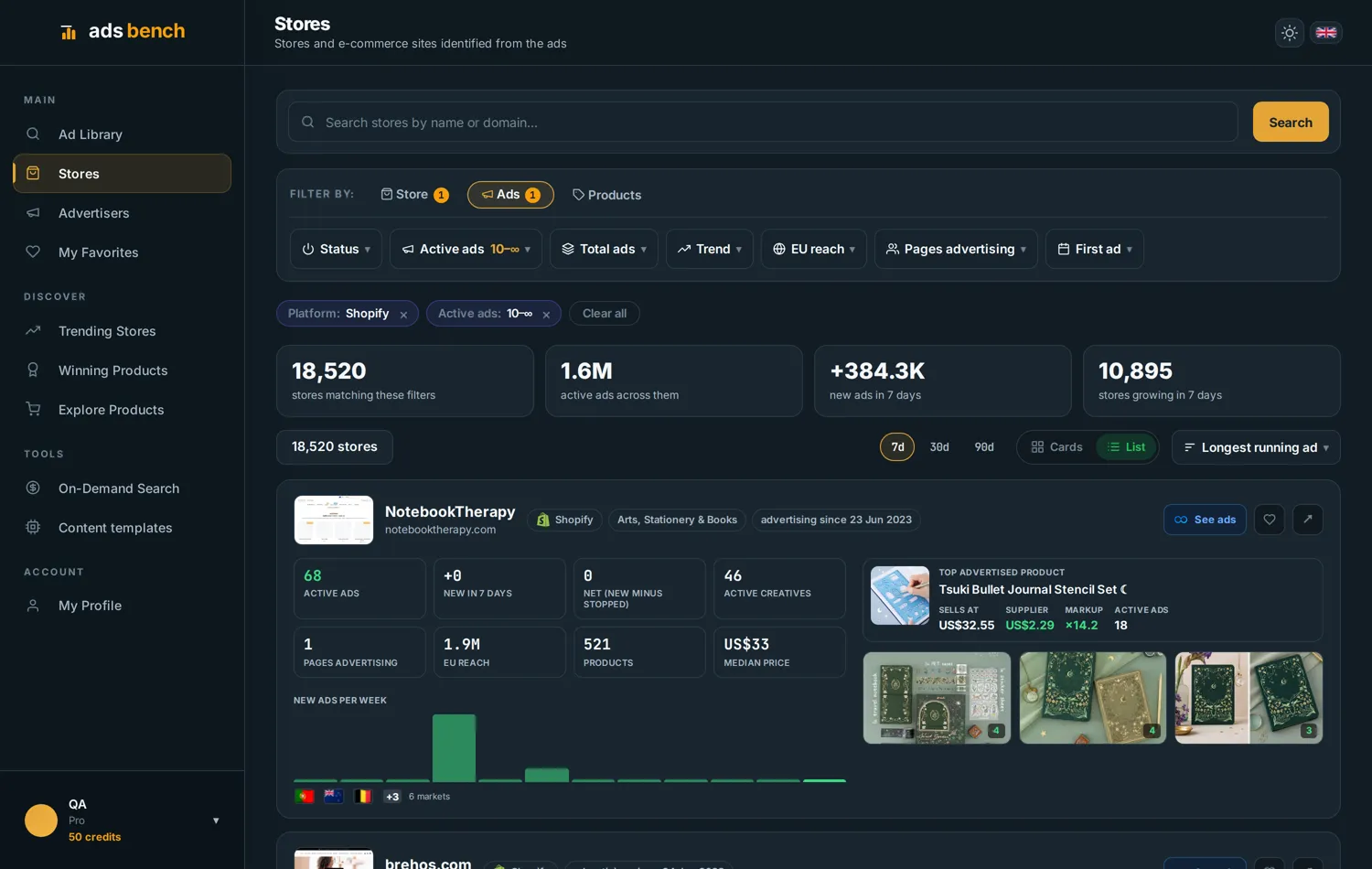
1. Open Stores and set Platform to Shopify.
2. Under Ads, set Active ads to 10 or more. On 28 October this left 18,520 stores.
3. Sort by Longest running ad. The stores at the top have had the same ad live for months.
4. In each row, check New in 7 days. Skip stores at +0 this week: they are coasting. The first store in the screenshot is one of them.
5. Open the store. The page shows new ads per week, the most advertised product with its supplier price, and every creative. Add a category or country filter to stay in your niche.
Limits of these numbers
We only see stores that advertise on Meta (Facebook and Instagram). A store that sells through TikTok, Google or SEO without Meta ads is invisible here.
Coverage is strongest in the countries we search most: the United Kingdom, Australia, the United States and Europe. Brazil, for example, is almost absent.
Ads are a signal of sales, not proof. Some stores keep ads running at a loss to build a brand, and a store with many ads may sell little per ad.
The first ad we saw is the first one in our data, which can be later than the store's real first ad.
Shopify store FAQs
How do I find Shopify stores in my niche?
Search site:myshopify.com plus the niche on Google, or search the niche keyword in the Meta Ad Library and follow the ads to the stores. To filter by activity, use a store database with a category filter, like the Stores page in Ads Bench.
How do I find successful Shopify stores?
Look for three signals in the Meta Ad Library: 10 or more active ads, new ads in the last 7 days and an ad live for 90 days or more. In our data, only 3.5% of Shopify stores pass all three.
Can I see how much a Shopify store sells?
No. Shopify does not make sales public. Best sellers (/collections/all?sort_by=best-selling) and the store's ads show what is selling, but not how much.
How do I know if a website is a Shopify store?
Add /products.json to the domain. If it returns a list of products, the store runs on Shopify. Images from cdn.shopify.com are another sign.
Are all Shopify stores dropshipping?
No. Shopify is used by brands with their own stock as well as by dropshippers. See how to tell if a store is dropshipping.
Data: Meta Ad Library ads collected by Ads Bench up to 28 October 2026, Shopify stores with a product catalogue only (117,102). Niche: the category of most of the store's products. Sales are not public: the signals in this article are based on advertising.