The short answer: it works, but Europe is 16 markets
We looked at the e-commerce stores that had active Meta ads (Facebook and Instagram) on 21 October 2026 and advertised in at least one of 16 European countries: Germany, France, Italy, Spain, the Netherlands, Belgium, Portugal, Ireland, Poland, Sweden, Denmark, Finland, Greece, the United Kingdom, Switzerland and Norway. That is 55,872 stores.
The data shows three things. Most stores pick one country and stay there. Outside the eurozone, half of the stores charge in the local currency. And creatives are short-lived everywhere: only 18% reach a month of runtime.
Why look at ads? A store rarely keeps ads running for weeks unless it is selling. Ads are the best public signal of where sales are happening. This is not the whole market, only the stores Ads Bench tracks. The limits are at the end of this article.
How many stores advertise in each country
The table shows, for each country, how many stores had active ads there, how many ads that was, and how many of the creatives launched in July or August reached 30 days of runtime.
Do not read the first column as market size. We search some countries more often than others (Portugal and the United Kingdom, for example), which inflates their numbers. Compare the other columns, which depend less on that.
In almost every country, the typical store runs only 2 or 3 active ads. The average is higher because a few large stores run hundreds. In Belgium, Switzerland and Germany, stores run more ads per store than anywhere else: more competition for the same customer.
| Country | Active stores | Active ads | Ads per store | Creatives 30+ days |
|---|---|---|---|---|
| United Kingdom | 34,755 | 561,086 | 16.1 | 21.6% |
| Portugal | 15,673 | 296,694 | 18.9 | 17.4% |
| Italy | 8,358 | 113,394 | 13.6 | 18.6% |
| Belgium | 7,782 | 186,948 | 24.0 | 17.7% |
| Germany | 7,715 | 158,391 | 20.5 | 14.6% |
| Spain | 7,491 | 106,235 | 14.2 | 14.6% |
| France | 6,932 | 123,861 | 17.9 | 15.5% |
| Netherlands | 6,579 | 89,539 | 13.6 | 13.2% |
| Ireland | 6,166 | 72,848 | 11.8 | 16.0% |
| Poland | 5,191 | 72,367 | 13.9 | 16.7% |
| Sweden | 3,762 | 62,226 | 16.5 | 13.0% |
| Greece | 2,929 | 27,525 | 9.4 | 16.9% |
| Denmark | 2,841 | 47,195 | 16.6 | 15.6% |
| Switzerland | 2,663 | 63,073 | 23.7 | 10.5% |
| Norway | 1,797 | 16,651 | 9.3 | 10.9% |
| Finland | 1,591 | 20,955 | 13.2 | 12.7% |
Active stores: e-commerce stores with active Meta ads on 21 October 2026, by the country where Meta says each ad was shown. A store advertising in several countries counts in each one. Ads per store: average. Creatives 30+ days: of the creatives launched between 1 July and 31 August 2026, those that reached 30 days of runtime.
4 in 5 stores pick a single country
Of the 55,872 stores, 45,565 (81.6%) advertise in only one of these 16 countries. Only 4.6% advertise in four or more. And 13.9% also advertise outside Europe (the United States, Canada, Australia or New Zealand).
When a store goes into two countries, it usually picks neighbors that share a language: Belgium and the Netherlands (870 stores), the United Kingdom and Ireland (637), Switzerland and Germany (433), Belgium and France (338).
The lesson is simple: start with one country, with your store in its language. Adding a neighbor that speaks the same language later is cheap, because the store, the ads and the customer support are already in place.
| European countries the store advertises in | Stores | % of stores |
|---|---|---|
| 1 | 45,565 | 81.6% |
| 2 or 3 | 7,722 | 13.8% |
| 4 to 6 | 1,614 | 2.9% |
| 7 or more | 971 | 1.7% |
E-commerce stores with active ads on 21 October 2026 that advertised in at least one of the 16 countries (55,872).
Outside the euro, charge in the local currency
In eurozone countries, most stores charge in euros: among the stores whose currency we could read, it ranges from 61% in Ireland to 86% in the Netherlands.
Outside the euro, the picture changes. In Poland, Sweden and Denmark, about half of the stores charge in the local currency (zloty, Swedish krona, Danish krone). In Switzerland and Norway, almost no store charges in Swiss francs or Norwegian kroner: most charge in euros, and many in dollars. These are stores from other countries that also sell there.
If you advertise in a country outside the euro, show prices in its currency. The main store platforms let you display prices in several currencies. Shoppers understand the price at a glance and are not surprised by their card statement.
| Country | Local currency | Euro | US dollar |
|---|---|---|---|
| Poland | 53.9% | 19.7% | 9.1% |
| Sweden | 52.2% | 25.9% | 12.7% |
| Denmark | 52.1% | 25.2% | 11.2% |
| United Kingdom | 35.5% | 28.4% | 15.0% |
| Switzerland | 1.2% | 69.8% | 21.9% |
| Norway | 0.9% | 51.6% | 31.2% |
Stores with active ads that advertised in each country, by the store’s currency. The rest charge in another currency or we could not read their currency (up to 19% in the United Kingdom).
What sells most in Europe
In all 16 countries, the category with the most stores advertising is clothing. Among the 23,209 stores whose category we know, 27.7% sell clothing, 12.5% beauty, 9.4% jewelry and watches, 8.9% health and wellness and 6.8% home and decor.
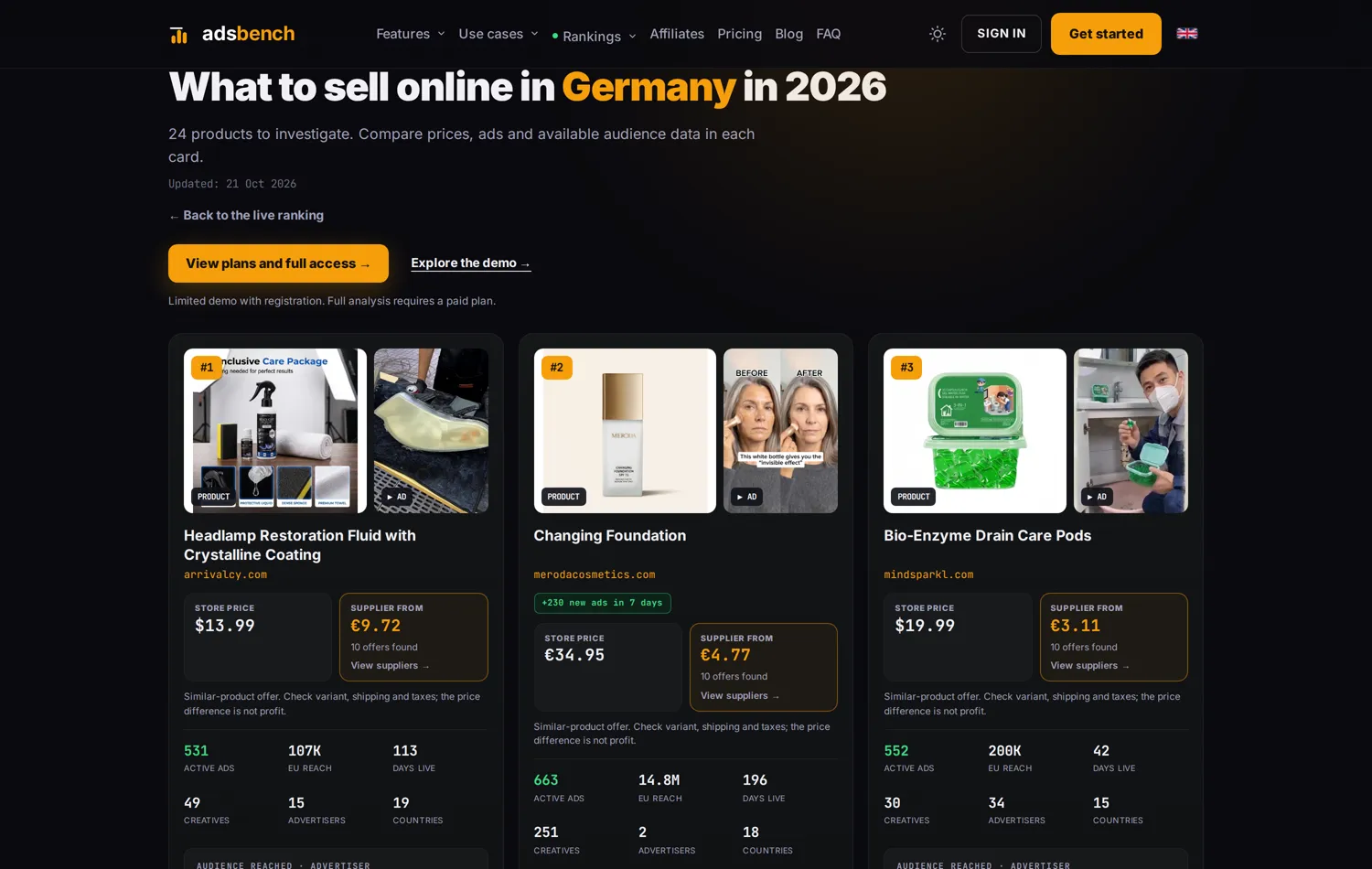
A category says little about which product will work. To see what is selling right now, open the Ads Bench country pages: the products with the most active ads in Germany, France, Spain and Italy. To pick a niche, read our guide to the best niches for dropshipping.
Most creatives are switched off in the first week
We followed the 3.6 million creatives that stores started running in these 16 countries in July and August 2026 (each different image or video counts as one). 65.6% were switched off within 7 days. Only 18.2% reached 30 days of runtime.
It varies little from country to country. The United Kingdom has the largest share of creatives lasting a month (21.6%), Germany sits at 14.6% and Switzerland at 10.5%. Everywhere, your budget also has to pay for the creatives that will not work.
In 14 of the 16 countries, more than half of the active ads are videos. The exceptions are Italy (49.9%) and Greece (43.9%). In Portugal it reaches 70%. To study competitor creatives, see how to analyze Facebook ad creatives.
What changed in 2026: the €3 duty per item
Until 30 June 2026, parcels worth up to €150 coming from outside the EU paid no customs duty, only VAT. Since 1 July 2026, they pay a flat €3 duty per different item in the parcel. The rule applies until 1 July 2028; after that, each product's normal duty rates apply (Council of the EU).
"Different item" means a different customs classification, not quantity. In the European Commission's example, five identical T-shirts pay €3, while one T-shirt and one watch pay €6 (Commission guidance).
In dropshipping, this weighs most on cheap products. On a product sold for €15, €3 is 20% of the price. At the typical price of stores advertising in the EU, about €34 ($39), it is around 9%. And 11% of those stores have a typical price below €15.
VAT stays the same. On parcels up to €150, a seller using the IOSS charges the customer's country VAT at checkout. Without the IOSS, the customer pays VAT on delivery, and the carrier may add a handling fee. In general, a seller based outside the EU needs an EU-established intermediary to register for the IOSS (IOSS portal).
Other rules for selling in the EU
EU responsible person (GPSR). Since 13 December 2024, a product sold in the EU needs a responsible person established in the EU: the manufacturer, the importer, an authorized representative or the fulfillment service provider. The product page in your store must show the manufacturer's name and contact details and, if the manufacturer is outside the EU, those of the responsible person, plus any safety warnings (Regulation (EU) 2023/988).
14-day returns. For online purchases, customers in the EU can withdraw within 14 days without giving a reason (Directive 2011/83/EU). Factor this into your margin, especially for clothing.
The United Kingdom, Switzerland and Norway are outside the EU and have their own VAT and customs rules. The €3 duty and the IOSS do not apply there.
This is a starting summary, not legal or tax advice. Check with an accountant in the country where you plan to sell.
How to start in Europe, step by step
Before your first ad, answer these questions:
| Question | Where to check |
|---|---|
| Which country will I start with, and is my store in its language? | The country table above and the Ads Bench country pages |
| Has this product been selling in that country for more than 30 days? | Our guide on how to find winning products |
| How many stores already sell the same thing there? | The saturation checklist |
| After the €3 duty, shipping and VAT, is there still a margin? | Our article on dropshipping profit margin |
| Outside the euro, are prices shown in the local currency? | Your store’s currency settings |
| Who is the EU responsible person for the product? | Your supplier or an authorized representative, before you sell |
Limits of these numbers
Ads Bench does not have every Meta ad. We find stores through daily searches of the Ad Library, and we search some countries more than others. So the country totals are there to compare the other columns, not to measure the size of each market.
An ad’s country is the one Meta reports as a country where it was shown. We only count these 16 European countries: others, such as Austria, are left out.
Currency and category are read from the store itself. We could not read the currency of some stores, and the category exists for only 23,209 of the 55,872.
We check each ad daily in its first week, weekly up to 30 days and monthly after that. Some ads counted as active may already have stopped.
Dropshipping in Europe: common questions
Does dropshipping work in Europe?
It works for stores that treat each country as its own market. We found 55,872 stores with active ads in 16 European countries in October 2026, and 4 in 5 advertise in a single country, in its language.
Is dropshipping legal in Europe?
Yes. But the store has to follow the rules for selling in the EU: VAT (through the IOSS for parcels up to €150), an EU responsible person for the product (GPSR) and the 14-day right of withdrawal. This article is not legal advice.
What is the best European country for dropshipping?
It depends on the language you speak and on the product. Most stores we track stay in one country. When they add a second, they pick a neighbor with the same language: Belgium and the Netherlands, the United Kingdom and Ireland, Switzerland and Germany.
How much is the new €3 duty?
€3 per different item in each parcel worth up to €150 coming from outside the EU, from 1 July 2026 to 1 July 2028. Five identical units pay €3; two different products pay €6.
Do I need a European supplier?
It is not required. But since July 2026 every item coming from outside the EU pays €3, and the product needs an EU responsible person. On cheap products, that can make a supplier with stock in Europe worth it. Run the numbers for your product.
Data: Meta Ad Library ads collected by Ads Bench up to 21 October 2026, e-commerce stores only (55,872 with active ads in 16 European countries). Creatives: those launched between 1 July and 31 August 2026 (3.6 million). EU rules: summary of the official sources linked in the article, not legal or tax advice.